Most of our clients follow a familiar path.
They launch on a website builder because it is fast, simple, and “good enough.” It gets them online quickly. It lowers risk. It helps them test messaging, offers, and positioning without a heavy upfront investment.
Then the business grows.
The website stops being a digital brochure and starts becoming a growth engine. Now it needs to:
- Load faster
- Rank better
- Convert better
- Integrate with more tools
- Support regular updates without friction
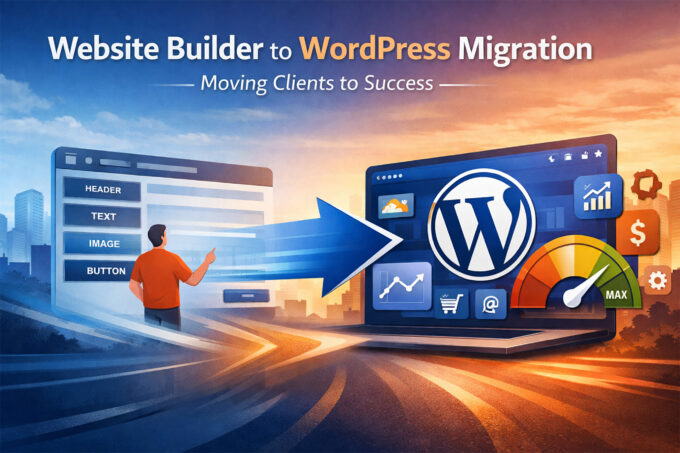
That is the moment when a website builder to WordPress migration becomes a smart business move.
The mistake many agencies make is framing the switch like a correction — as if the builder was a bad decision. We do not do that.
Our job is not to shame the past. Our job is to position WordPress as the next-stage platform, aligned with where your business is going.
Builders are not the enemy
If we opened with “WordPress is better,” we would force you to defend your current setup. That slows everything down.
Instead, we start by validating why your builder worked:
- It got you live quickly.
- It reduced complexity early on.
- It helped you validate demand.
- It let you manage the site without a technical team.
That was the right tool for that stage.
Then we introduce the upgrade logic:
“Your current site did its job. It helped you get here. WordPress is what we use when the site needs to actively drive growth.”
That small shift changes the entire tone. We are not arguing about platforms. We are aligning tools to business maturity.
It also helps to know that WordPress is not a niche choice. According to W3Techs, as of January 2026, WordPress is used by 60.0% of all websites whose CMS is known — representing 42.8% of all websites globally. This is mainstream infrastructure for serious businesses.
The real triggers that signal it is time to move
You rarely wake up wanting a new CMS. You wake up wanting a result.
Our job is to connect that result to the right platform.
1. Performance becomes revenue
When you are running paid traffic, publishing content consistently, or competing in search, speed becomes commercial.
In Deloitte’s “Milliseconds Make Millions” study (by Deloitte), researchers found measurable improvements in engagement and conversion tied to very small mobile speed gains — including retail transaction uplifts from just a 0.1 second improvement in key speed metrics.
That gives us a clean bridge:
If performance is part of your growth engine, we need to treat your website like a performance asset, not a template.
2. SEO and content scale
As your marketing matures, so does your content strategy:
- Topic clusters
- Landing page testing
- Internal linking
- Schema
- Technical clean-up
- Editorial workflows
Builders can handle some of this. But we often hit ceilings around structure, flexibility, and workflow efficiency.
WordPress gives us the control to build scalable content systems — not just publish pages.
3. Your marketing stack gets heavier
Over time, your site connects to:
- CRM systems
- Email marketing platforms
- Analytics and event tracking
- Heatmaps
- Lead routing logic
- Automation workflows
The stack grows. The site has to keep up.
This is also where migrations often break — email and domain configurations. When we manage hosting, SSL, backups, and domains in a unified setup, we reduce moving parts and protect stability during the transition.
4. Ownership and portability matter
Some clients begin to ask:
“What happens if we ever want to move?”
Even if you never plan to, having portability reduces risk. WordPress gives you long-term control instead of tying you to a single ecosystem.
5. E-commerce shifts from “selling” to “optimizing”
If you are serious about ecommerce, customization becomes critical:
- Checkout flexibility
- Subscriptions
- Bundles
- Advanced integrations
That is where WordPress combined with WooCommerce often becomes the “we can customize anything” path.
How we frame WordPress as an upgrade (not a correction)
We use a simple three-part narrative:
Launch fast: Builders win when speed-to-launch is the priority.
Prove demand: Builders are excellent for validating offers and messaging.
Scale: WordPress wins when you need performance, flexibility, and long-term control.
Then we connect it to your current goals:
- You want more qualified leads → we need better landing pages and faster load times.
- You want consistent organic growth → we need scalable content architecture.
- You want campaign agility → we need a platform built for iteration.
And often we say it plainly:
“Nothing is wrong with your current platform. It is just not designed for what you are trying to do next.”
That removes defensiveness immediately.
Migration vs rebuild: how we decide
Not every move to WordPress looks the same. Protecting your rankings, conversions, and investment depends on choosing the right approach.
We choose a migration when:
- You have valuable blog content.
- Rankings and URL structure matter.
- The design is fine, but execution is limited.
- You want minimal visual change.
We preserve structure, replicate design thoughtfully, then optimize.
We choose a rebuild when:
- The site is a patchwork of outdated experiments.
- Messaging has evolved.
- Design is not conversion-led.
- The builder theme is bloated.
We start with strategy, refresh information architecture, design for conversion, and selectively migrate content.
We choose a hybrid when:
- SEO equity must be protected.
- Core pages and blog content stay.
- High-impact landing pages are redesigned for performance.
We make this decision through a short paid audit — not guesswork. That ensures recommendations are strategic, not reactive.
Common concerns (and how we handle them)
“We are already ranking.”
Perfect. Our goal is preservation plus improvement.
We:
- Keep URL slugs where possible
- Map 301 redirects carefully
- Migrate metadata
- Validate sitemaps and indexation
- Monitor post-launch
WordPress is not a reset if it is handled correctly.
“WordPress sounds harder to use.”
It can be — if it is built like a developer playground.
We build around your real workflow. You get a clean editing experience with structured templates, while we maintain deeper control behind the scenes.
“Is WordPress secure?”
WordPress is secure when it is managed properly.
Most security problems come from:
- Outdated plugins
- Weak credentials
- Poor hosting environments
We standardize updates, backups, access control, and security layers from day one.
“This sounds expensive.”
It is an investment. But friction has a cost too.
If your team spends hours fighting platform limitations every month, you are already paying. We simply convert hidden friction costs into structured growth infrastructure.
“We cannot afford downtime.”
Neither can we.
We build in staging, QA thoroughly, and plan controlled go-live windows. Downtime is not the default — it is a managed risk.
Our migration playbook
Consistency protects your results.
1. Full audit
We inventory:
- Core pages and blog posts
- Top organic landing pages
- URL structure
- Forms and conversion points
- Integrations
- Ecommerce flows (if relevant)
2. Define the source of truth
Builder platforms often scatter content across widgets and blocks. We extract clean content first, then rebuild design using performance-first templates.
3. Staging build (non-negotiable)
You see everything before launch. We QA thoroughly before switching domains.
4. Content and media migration
We plan for:
- Manual page recreation where necessary
- Image compression and naming
- Internal link updates
- Embedded assets
5. SEO protection
We:
- Preserve URL slugs where possible
- Implement 301 redirects
- Retain metadata
- Validate robots rules
- Confirm sitemap integrity
6. Performance and security baseline
Before launch, we lock in:
- Caching and compression
- Image optimization
- Database clean-up
- SSL configuration
- Backups and update policy
7. Launch, monitor, stabilize
After go-live:
- We monitor Search Console and analytics
- Fix 404s quickly
- Watch top landing pages
- Maintain a 2-week stabilization window
This keeps support structured — not open-ended.
We align the migration to your goals
You are not buying WordPress.
You are buying outcomes.
We anchor the project to goals you already care about:
- Faster landing pages for paid traffic
- Scalable publishing for organic growth
- Ecommerce flexibility for higher AOV and retention
- A site your team can update weekly without breaking things
Performance conversations become commercial, not technical.
And you are not choosing a fringe solution. WordPress remains the dominant CMS globally.
How we package it
Clear packaging removes ambiguity.
1. Builder-to-WordPress Migration (SEO-preserving)
Best for content-rich, stable brands.
Includes:
- Page inventory + redirect plan
- Content migration
- Template build
- Performance + security baseline
- Launch + stabilization
2. Rebuild for Growth (strategy-led)
Best for businesses that have completely outgrown the old site.
Includes:
- Messaging and IA refresh
- Conversion-focused templates
- Selective content migration
- Performance-first build
- Launch + optimization roadmap
3. Ongoing Care Plan
This is where long-term value compounds.
Includes:
- Updates and backups
- Security monitoring
- Performance checks
- Monthly improvements
- Quarterly conversion reviews
WordPress becomes the foundation for recurring optimization — not a one-time project.
The bottom line
A website builder is often the right choice early on.
WordPress becomes the right choice when the site needs to drive growth.
Moving from a builder to WordPress is not a platform debate. It is a growth conversation.
When we position WordPress as the next stage — not a correction — the decision feels natural, not defensive.
You always have a simple choice:
Keep the current site and accept the current limits.
Or upgrade to a platform built to support the next 12–24 months of growth.
And once your site is on WordPress, the real win begins.
We are no longer “maintaining a website.”
We are optimizing a growth asset — one that evolves with every campaign, every product shift, and every new customer insight.